
Building a study planner app - Studia
The goal is simple - how to organise and chunking content into manageable revision sessions/slots. Sign up for free beta!
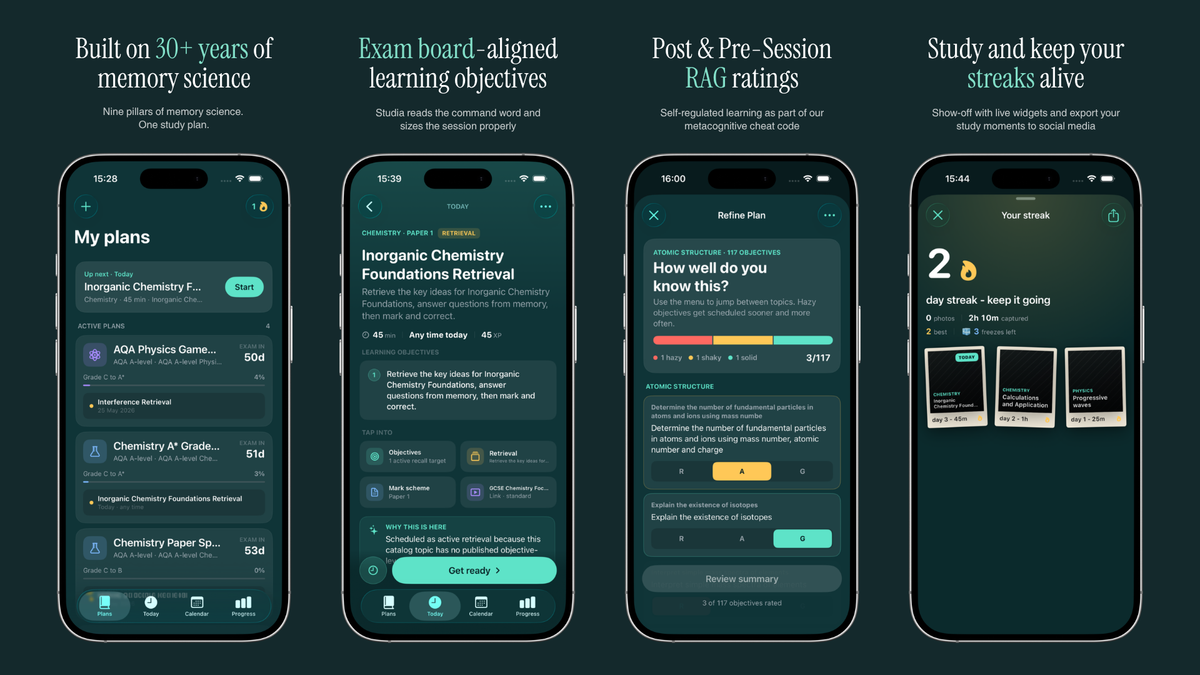
I've been dabbling into iOS apps recently especially with Claude and Codex on my side, and the other day I downloaded Runna app (the running app) which their onboarding process to build a running plan really captured my attention. Then, a classic a-ha moment, I thought, why don't I make a similar app but to help students structure their revision into a plan - surely someone already done this? I've been looking around, and nothing really strikes me. So, I fired up Xcode and build Studia.
If you'd like to be a beta tester, click below to be entered as one of my TestFlight participants!
P/S: It is Apple devices (iOS/iPad OS) only and you'd need to download Apple's TestFlight app.
The idea was simple. Students create a plan by answering a few questions:
- What is the qualification they're studying
- What is their focus
- What days they're planning to work/revise
- How long per session they planning to commit
- What days they can do longer session
- When is their test or exam
- What grade they are at and what grade they're aiming for
Based on all of this input, the algorithm heuristically comes up with a plan. No use of AI this time (maybe future?).
Studia's custom engine
The algorithm - or I call it our custom engine - decides what to study, when and in what order, so every session is purposeful as possible. I tried to ground this based on three main 'pillars':
- Spaced repetition - the classic Ebbinghaus forgetting curve.
- Retrieval practice - the "testing effect" by actively recalling information which strengthens memory far more than re-reading.
- Interleaving - mixing related topics, rather than studying them in isolated blocks builds more durable understanding.
Based on the above, our engine - in short - try to do the following:
- Break the syllabus into smallest meaningful pieces. Instead of scheduling a vague three-hour "Biology" block, the engine works at the level of individual concepts or learning outcomes. This means spacing and review can be applied precisely, to the exact things they're still not solid.
- Every session pairs learning with review - new material never arrives alone. The engine can see the big picture and threads earlier concepts back through their sessions at expanding intervals, so they're recalling right on the edge of forgetting.
- The plan 'rebalances' as their exam or test approaches. Their real progress rarely matches the ideal, so as the deadline tightens and some topics prove harder than others, the engine continuously reshuffles what comes next. When the time runs genuinely short, it makes the hard trade-offs deliberately, instead of quietly leaving students under prepared.
Of course there's more to this in terms refining everything while not getting into specifics. But the goal is simple: open the app, trust the plan, and spend their energy studying instead of figuring out what to study.
Studia in action
To download the beta app, click link below. Share your feedback by screenshotting any screens on anywhere while on the app, and they will prompt a feedback comment section.
References
- Ebbinghaus, H. (1885). Über das Gedächtnis (Memory: A Contribution to Experimental Psychology).
- Cepeda, N. J., Pashler, H., Vul, E., Wixted, J. T., & Rohrer, D. (2006). Distributed practice in verbal recall tasks: A review and quantitative synthesis. Psychological Bulletin, 132(3), 354–380.
- Roediger, H. L., & Karpicke, J. D. (2006). Test-enhanced learning: Taking memory tests improves long-term retention. Psychological Science, 17(3), 249–255.
- Karpicke, J. D., & Roediger, H. L. (2008). The critical importance of retrieval for learning. Science, 319(5865), 966–968.
- Rohrer, D., & Taylor, K. (2007). The shuffling of mathematics problems improves learning. Instructional Science, 35, 481–498.
- Dunlosky, J., Rawson, K. A., Marsh, E. J., Nathan, M. J., & Willingham, D. T. (2013). Improving students' learning with effective learning techniques. Psychological Science in the Public Interest, 14(1), 4–58.